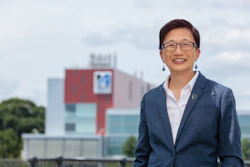
When Riverside Community College Chancellor Dr. Wolde-Ab Isaac leaves campus for the last time later this year, he will leave a legacy of unwavering equity and a career-long dedication to removing systemic barriers for Black and Brown students.
Log in to view the full article
When Riverside Community College Chancellor Dr. Wolde-Ab Isaac leaves campus for the last time later this year, he will leave a legacy of unwavering equity and a career-long dedication to removing systemic barriers for Black and Brown students.
While many leaders inherit longstanding, systemic issues of poverty, low opportunity, and disinvestment, Isaac has worked for 54 years to nd the root of the issues and work to eradicate the underlying issues to solve the issues that impact his students. A world-renowned scientist, Isaac’s approach to equity is to treat the factors that feed inequities not as inevitable facts, but as variables to be isolated and solved.
“It’s the power the recognition and the power of strategic planning to analyze the problem, to try to figure out a solution, to put it on a map in terms of all the steps that need to be taken to get to your endpoint, and then to determine the matrices for measuring, for quantifying exactly what are you achieving and why,” he said.
The Scientist’s Blueprint
This meticulous mindset was forged across decades and continents. A former Fulbright Scholar, Isaac’s academic journey took him from studying chemistry at Haile Selassie University in Ethiopia to medicinal chemistry at the University of Michigan, followed by postdoctoral work at Uppsala University in Sweden. Before transitioning to academia, he spent over a decade as a clinical researcher at AstraZeneca.
His career as a college leader began at the University of Asmara in Eritrea in 1993. By the time he arrived at Moreno Valley College as the Dean of Health Science, he was ready to apply his scientific precision to workforce development. He built programs in phlebotomy, emergency medical services, and medical transcription — creating tangible pathways to employment for his students.
After six years at Moreno Valley, he transitioned to Riverside College as Vice President of Academic Affairs, where he successfully navigated a daunting reaccreditation process that resulted in five commendations. By 2015, he was named the 11th president of Riverside College, focusing on restructuring academic programs through the state’s guided pathway institute to ensure enrollment growth translated into student completion.
The Architecture of Accountability
When Isaac was appointed Chancellor in December 2017, strategic planning became his primary vehicle for transformative change. “We also use a strategic plan as a very powerful tool for accountability,” he explained.
His vision was one of synergies; he believes a well executed plan could make the three colleges within the district far more impactful together than they were apart. But he knew the institution’s capacity could not be built in isolation; it had to be grounded in deep, community wide partnerships.
Bridges Beyond the Campus
Isaac’s leadership pushed the district to look beyond its own gates, partnering with K-12 school districts to develop a shared mission. The goal was clear: increase the “capture rate” of high school graduates and move them toward prosperity. This resulted in innovative “opt-out” models where every high school graduate was automatically admitted to the district, removing a major hurdle to access.
“The students that are with us today will be theirs tomorrow, just like the students that are with the K-12 today, they will be with us tomorrow,” Isaac says. He championed dual admission and guaranteed transfer pathways to institutions like UC Riverside and Cal State, ensuring the pipeline to a four-year degree was seamless.
A Sense of Belonging
For Isaac, equity also meant fostering a true sense of “belongingness.” In a unique “experiment,” the district negotiated with the University of California, Riverside to co-build a student residence hall on the UCR campus. The dorms were designed to be indistinguishable from one another, allowing community college students to be fully mingled with their university peers.
Everything Isaac has accomplished stems from a profound sense of care and a scientific belief in the power of accountability to improve lives.
“Growing up, I could only expect to receive, because I had nothing to give,” Isaac says. “To be in a place where I’m able to give is a tremendous privilege.”
This article originally appeared in the June 2026 print edition of The EDU Ledger.