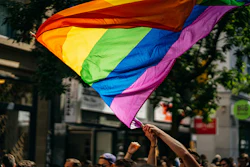
Boston University President Melissa Gilliam says she is “deeply sorry” for forcing the removal of LGBTQ+ pride flags from campus, and announced Tuesday a temporary pause on enforcement of the university’s “content neutral” signage policy prohibiting posters, banners, and flags from being affixed to outward-facing university property (like windows and doors).
Though the policy has long existed, the institution has only recently sought to enforce it, hoping to avoid the appearance of the school endorsing specific political or social messages.
The enforcement — which occurred largely over spring break and included the removal of flags from the Women’s, Gender, and Sexuality Studies department — sparked intense protests from faculty and students who viewed the move as selective targeting and a threat to LGBTQ+ safety and visibility on campus.
The bigger picture:
The failure of Gilliam, who previously espoused her commitment to building an inclusive campus community where students felt not only welcomed but at home, to consider how forcing the removal of pride flags on campus might have alienated members of the campus community, is perhaps a reflection of the chaotic and reactive times higher ed leaders are operating in.
By enforcing a strict content-neutral policy, the administration is likely attempting to insulate the university from federal scrutiny or culture war legislation that could jeopardize these hundreds of millions in research dollars. As a Research 1 institution, Boston University received nearly $575 million in federal funding in FY25. And as the Trump administration continues to work to dismantle inclusion efforts, university leaders are working to avoid the ire of Federal funders.
“Everybody that had this [Research 1] institution [designation], they’re so afraid to see the good work they have done lost ... while [the Trump administration] is weaponizing the dollars that are associated with that,” Association of Governing Boards President and CEO Ross Mugler told the EDU Ledger in a separate discussion about the role of leaders to advocate for diversity and inclusion on campus.
However, this reactive framing harms students on campus who are trusting the university to not only provide a high-quality education, but to keep them safe and welcome them “home.”
"Institutions have to evolve, and they have to reflect the society in which they’re operating,” Mugler said, adding that institutions that stray away from the core values of diversity, equity, and inclusion as codified into the institutional mission, vision, and values will not be able to operate in a world that is increasingly more diverse.