"They want it to open tomorrow. They are ready,” says Dr. David K. Wilson, president of Morgan State University in a recent interview. The “it” his students are “clamoring for” is a medical school for the urban Baltimore, Maryland campus.
Log in to view the full article
"They want it to open tomorrow. They are ready,” says Dr. David K. Wilson, president of Morgan State University in a recent interview. The “it” his students are “clamoring for” is a medical school for the urban Baltimore, Maryland campus.
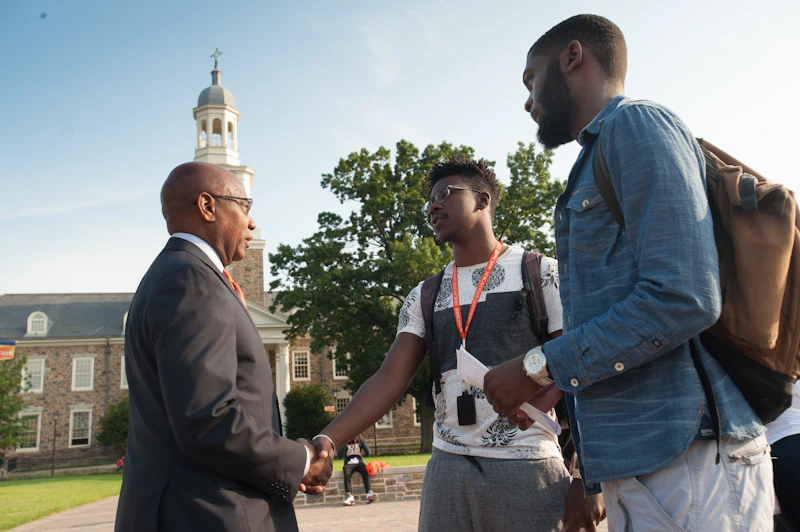 PHOTOS COURTESY OF MORGAN STATE UNIVERSITY
For now, says Wilson, the focus will be on fundraising and devising “a comprehensive plan” to develop the university’s own public, nonprofit Doctor of Medicine (M.D.) program — a first for the state’s largest Historically Black University. Wilson said the two-year, $1.75 million grant it received from the Robert Wood Johnson Foundation will be used to fuel the work of a new, “in-house medical school planning group.” He appointed Farin Kamangar, M.D., a cancer epidemiologist and associate vice president for research, and Vinnie John, associate vice president and chief operations officer, the group’s co-chairs. Wilson said efforts are also underway to form an external advisory group.
“This investment represents a pivotal moment for Morgan and for the communities we serve,” Wilson said. “For more than a decade, we have been committed to the idea that a medical school on our campus can be transformative — not only for our students but for the state of Maryland and the nation.”
 Inside the new Health and Human Services Center at Morgan State University.COURTESY OF MORGAN STATE UNIVERSITY
“At Morgan, we’re serious about our research. You know, we are on the cusp of becoming an R1,” offers Wilson about the quest to attain R1 status. “I see what’s about to happen as a marriage between our MD medical school and our R1 university and the opportunities it will offer our students and faculty.”
Morgan State set a new record in fiscal year 2025, when it earned “$104.4 million in sponsored research funding, marking the first time it had exceeded $100 million in research commitments within a single fiscal year.
“Reaching this milestone, in addition to establishing several critically relevant public impact research centers, underscores Morgan’s steady ascent toward achieving an R1 (very high research activity) Carnegie classification,” according to a university report. Howard University in Washington, D.C. is the only HBCU to earn R1 status, which requires a university to spend at least $50 million annually on research and development and award its graduate students at least 70 research doctorates annually, according to the American Council on Education.
A pivot and a plan
About five years ago, the university was planning to launch an affiliated, for-profit, school of osteopathic medicine, which would operate privately, not by the public Morgan State. Based on projections, that proposed college of osteopathic medicine was to admit its first cohort of students in 2025. Those plans, which began in 2020, have since ended and a private funder partnership with the university has dissolved. Along the way, says Wilson, those efforts stalled. He attributes it to the pandemic, investor concerns, and leadership.
Eager and “excited,” Wilson is embarking on a long road with a new vision for a non-profit, affordable, medical school model, but when asked about lessons learned, he says there were some. The decision to pivot, he says, revealed things like how critical good leadership is, the importance of timing, knowing how to navigate the accreditation process, meeting deadlines, and the need to forge relationships ahead of getting students placed in local residency programs.
This time, plans for a public, non-profit medical school would give Morgan State full control over “hiring faculty, planning the curriculum, and operations,” says Wilson. He projects the school will enroll as many as 120 students a year when it opens, which may not happen until 2028 or even 2030.
For the journey forward
For Dr. Deborah Prothrow-Stith, dean of the Charles R. Drew University of Medicine and Science, the process of gaining coveted medical school accreditation and getting an inaugural class of future doctors to the finish line, is daunting, still fresh, and unfolding for the Historically Black Graduate Institution in South Los Angeles. “We expect to be fully accredited in 2027,” and graduate an inaugural class of physicians, says Prothrow-Stith, of the now private, independent medical school. It welcomed its inaugural class of 60 medical students in 2023. For years, Charles Drew partnered with the University of California, Los Angeles, to jointly train medical students.
Charles Drew is one of four Historically Black medical schools in the country. The other three are Howard University College of Medicine, in Washington, D.C.; Meharry Medical College, in Nashville, Tenn.; and Morehouse School of Medicine, in Atlanta, Ga. Xavier University of Louisiana, the nation’s only Historically Black Catholic university, is poised to join the four. In 2022, Xavier first announced plans to establish a medical school in partnership with Ochsner Health, a not-for-profit academic healthcare provider, to form the Xavier Ochsner College of Medicine in New Orleans.
“Launching an accredited medical school is a very intense process,” Prothrow-Stith points out. And the journey is not only real, it’s long. “For us, it’s been five years, and we weren’t starting from scratch. For example, we were already operating a residency program.” It’s sobering advice she shares with Wilson.
Prothrow-Stith says she also wants Wilson to be assured, “It can be done. I have full confidence that they [Morgan State] can do it, and we stand willing and ready to help in any way we can.”
Wilson says he is grateful for the community of HBCU medical school leaders who are accessible and like Prothrow-Stith, have reached out. “They understand the challenge. There is no competition, but support. I expect to involve them as medical school advisors,” Wilson added.
From its expansive campus in majority-Black Baltimore City, “Morgan is committed to establishing a world-class medical school where students who want to become doctors can realize their dreams. That’s what’s driving us,” Wilson says. “We see the excitement, the need, and the opportunity.”