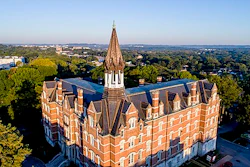
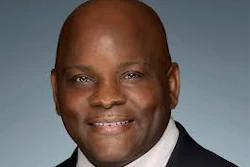
Actress and former Howard University Dean Phylicia Rashad with Richard Smallwood at a 2024 Howard University tribute. The two were classmates in the early 1970s.Photo courtesy of Howard University.
Born in Atlanta and raised in the D.C. area, Smallwood's musical origins trace back to his stepfather's founding and pastorship of Union Temple Baptist Church in the district's southeast quadrant during the 1950s. He began to play piano by ear at age five, started formal music training by seven, and formed his first gospel choir by 11. Howard alumna Roberta Flack, who would become a musical genius in her own right, was Smallwood's eighth-grade music instructor at the former Hugh M. Browne Junior High School.
Smallwood's time at Howard University proved transformative, both for his own artistic development and for the institution's musical legacy. As an undergraduate, Smallwood joined the university's first gospel group, The Celestials, before becoming a founding member of the Howard University Gospel Choir, an ensemble that would go on to influence generations of gospel musicians and cement Howard's position as a crucible for sacred music excellence. He graduated cum laude in 1971 with dual degrees in classical vocal performance and piano, studying alongside future legends including Donny Hathaway and actresses Debbie Allen and Phylicia Rashad.
"Howard University birthed one of the best and brightest of HBCUs," said Reverend Jamal Bryant, senior pastor of New Birth Missionary Baptist Church, reflecting on Smallwood's early beginnings and the institution's role in shaping his artistry.
The rigorous classical training Smallwood received at Howard became the foundation for his revolutionary approach to gospel music. The university's emphasis on excellence and innovation encouraged him to push the boundaries of traditional gospel while maintaining its spiritual core. This unique blend—classical sophistication married to gospel fervor—would become Smallwood's signature sound.
Newly emboldened by his Howard education and experiences, Smallwood sought to contemporize the staid mores of gospel music on a broader scale. As music director of Union Temple's Young Adult Choir, Smallwood recorded and released his first two studio albums, 1974's "Look Up and Live" and 1976's "Give Us Peace." Inspired by mentor, friend, and fellow music legend Edwin Hawkins, Smallwood formed the Richard Smallwood Singers in 1977.
Their eponymous debut was released in 1982 and spent 87 weeks on Billboard magazine's Top Gospel Albums chart; their second album, 1984's "Psalms," topped the chart and earned Smallwood his first Grammy Award nomination. The Richard Smallwood Singers would record seven albums before disbanding, recording their finale live at Howard University in April 1993—a homecoming that underscored the enduring bond between the artist and his alma mater.
After graduating from Howard, Smallwood taught music at the University of Maryland, extending his influence beyond performance into pedagogy. His teaching career reflected his commitment to passing on both technical excellence and spiritual depth to the next generation of musicians.
1996 would prove to be a banner year for Smallwood. He reemerged in April with a new choir, Vision. Their inaugural project, "Adoration: Live in Atlanta," features "Total Praise," one of the compositions that came to define Smallwood's career and became what many consider a modern-day hymn. The song transcended denominational boundaries, performed in Black churches, white churches, and nondenominational congregations alike.
Later that year, "I Love the Lord"—originally featured on Union Temple's "Give Us Peace" album—was performed by Whitney Houston for her film "The Preacher's Wife." For Smallwood, this was not simply a high-profile placement; it affirmed his writing could move seamlessly from church pews to movie screens without losing its spiritual weight. The moment cemented Smallwood's position as both a minister-musician and a mainstream songwriter who could bridge gospel's tradition with its expanding global reach.
Smallwood's dedication to both spiritual formation and intellectual rigor led him back to Howard University in the early 2000s. He was ordained as a minister at D.C.'s historic Metropolitan Baptist Church in 2004 and subsequently became the church's Artist-in-Residence. That same year, he earned his second degree from Howard, a Master of Divinity.
He was inducted into the Gospel Music Hall of Fame in 2006 and continued releasing new music into the 2010s, concluding his 16-album catalogue with 2015's "Anthology Live." Among Smallwood's myriad plaudits are eight Grammy Award nominations, three Dove Awards, and seven Stellar Gospel Music Awards. On his 75th birthday in 2023, D.C. Mayor Muriel Bowser issued a proclamation declaring Dec. 1 "Richard Smallwood Day," and United States President Joe Biden awarded him the President's Lifetime Achievement Award.
In 1997, Howard University honored Smallwood with the Alumni Award for Distinguished Postgraduate Achievement. In April 2024, Howard's School of Divinity and the Chadwick A. Boseman College of Fine Arts co-presented a tribute to Smallwood and alumna and legendary gospel organist Elbernita "Twinkie" Clark, during which he received the university's Lifetime Achievement Award. The event featured performances by gospel powerhouses and choirs, including the Howard University Gospel Choir he helped establish decades earlier.
"Howard is my home, my heart, and I'm ever grateful for all that this fine institution has done for me over the years," Smallwood wrote in an appreciation post after the tribute. "From the bottom of my heart, thank you, Howard!"
In the days following his death, tributes poured in from across the gospel and music communities. Chaka Khan wrote on Facebook that Smallwood "opened up my whole world of gospel music. His music didn't just inspire me, it transformed me. He is my favorite pianist, and his brilliance, spirit, and devotion to the music have shaped generations, including my own journey."
Destiny's Child alum Michelle Williams paid tribute to "Maestro Richard Smallwood," thanking him for music that "ministered throughout this entire world."
"We mourn the loss and celebrate the life of highly esteemed musician, composer, pianist, arranger, and producer Rev. Richard L. Smallwood," said Howard University School of Divinity Dean Kenyatta Gilbert. "We hold our dear brother, his relatives, and friends in the light and commend him to our Creator God as he joins the ancestral family of the faithful."
"Through his music and ministry, Rev. Richard Smallwood invited listeners into moments of spiritual reflection, drawing them closer to God and offering peace, hope, and reassurance during life's most difficult seasons," said university Interim President and President Emeritus Dr. Wayne A. I. Frederick. "Howard University is profoundly proud to have played a role in his development as both a musician and a scholar, and we are grateful for the extraordinary global impact of a life lived in service through music."