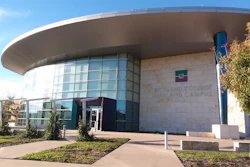
Students at Tidewater Community College in Virginia.Tidewater Community College
Community colleges are struggling to keep pace with surging demand for workers in advanced infrastructure, energy, and agriculture fields — a shortfall most acute in the nation's largest cities — according to a new national study released this month by the Community College Research Center at Columbia University's Teachers College.
The research brief analyzed job postings data from Lightcast and credential completion data from the federal Integrated Postsecondary Data System between 2010 and 2023. Researchers found that while these so-called AIREA jobs — a classification that spans wind turbine technicians, electrical line workers, truck drivers, HVAC installers, welders, and construction managers — accounted for 27% of all job postings over that period, community colleges produced credentials in those fields for only 17% of their completers.
The supply-demand gap is especially pronounced in major metropolitan areas. Using commuting zones as their unit of analysis, the researchers found that the vast majority of the country had a supply-demand ratio of 0.00 to 0.43 — meaning job postings significantly outstripped credential production. In the most underserved regions, more than six job openings were available for every credential awarded.
The study is an outgrowth of CCRC's Building a Sustainable Future initiative, launched in 2023 to examine how community colleges are preparing students for the green economy in the wake of historic federal investments — including the Infrastructure Investment and Jobs Act of 2021 and the Inflation Reduction Act of 2022.
Researchers say they quickly discovered that a narrow definition of green jobs missed the fuller picture. The green economy, they found, "relies on many occupations that, while not narrowly defined as green, require similar technical competencies and are equally central to the future workforce." That insight led them to develop the broader AIREA classification, encompassing 235 occupational codes and 429 distinct degree and certificate programs.
One of the study's most striking findings concerns wages. Using 2024 Bureau of Labor Statistics data, the researchers found that middle-skill workers in AIREA jobs — those requiring more than a high school diploma but less than a bachelor's degree — earn approximately 31% more annually than similarly credentialed workers in non-AIREA fields: $61,011 on average, compared to $46,710.
The report describes this wage gap as evidence that AIREA-related professions are "good jobs," offering compensation particularly competitive for candidates without four-year degrees. The researchers suggest the findings have significant implications for economic mobility, especially for students from underserved and rural communities.
Demand for these workers has also climbed sharply. From 2010 through 2022, transportation and material-moving occupations and installation, maintenance, and repair jobs saw especially dramatic increases in job postings. While posting volumes softened after 2022 — a trend researchers attribute in part to the easing of pandemic-era supply chain pressures — construction and extraction roles maintained sustained growth throughout the period.
On the credential side, AIREA completions at community colleges grew 69% between 2010 and 2023, rising from 142,312 to 240,610 — outpacing the 55% growth in non-AIREA fields over the same period. But the growth is heavily concentrated at the certificate level. AIREA programs accounted for 26% of all short-term certificates and 20% of long-term certificates awarded by community colleges, compared to just 10% of associate degrees and 4% of bachelor's degrees.
The top ten AIREA program areas — including welding, automotive technology, HVAC/R, electrician programs, and diesel mechanics — account for more than half of all AIREA credentials awarded.
The national undersupply masks significant regional variation. Some smaller and rural commuting zones, particularly in the Great Plains, Rust Belt, and parts of the South, show strong alignment between credential production and employer demand — or in some cases, actual surplus. The researchers note, however, that this likely reflects the lower absolute volume of job postings in those markets, rather than a model easily replicated elsewhere.
The nation's largest metropolitan labor markets, by contrast, "face a deepening green skills gap," the report states.
The authors say their findings carry direct implications for federal and state policymakers as well as community college administrators. They call for expanded investment in stackable credential pathways that allow students to enter the workforce quickly while preserving options for longer-term academic advancement. They also argue that workforce development strategies are "most effective when tailored to specific regional contexts rather than applied broadly."
The study was funded by JPMorganChase and the National Renewable Energy Laboratory. An interactive data tool allowing users to explore AIREA hiring trends and credential production by commuting zone is available through the Foundation for California Community Colleges and the University of Tennessee, Knoxville.