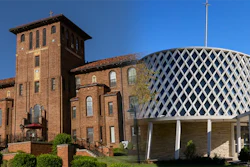
Woodworth Chapel, on the campus of Tougaloo College in Jackson, Mississippi.Visit Jackson
When Scott Colom took the stage Wednesday evening in front of the chapel on historic Tougaloo College’s campus in Jackson, Mississippi, it was not lost on him the history he had made, or what it meant to so many Mississippians.
“For me, this journey started with a prayer," he told the hundreds of people who had gathered on the campus 8 days after voting ended and just moments after the Mississippi Senate race was called in his favor. "And in Mississippi, our prayers have often changed the course of history.”
The day after the election, Colom made a point of stopping at three college campuses in Jackson — Tougaloo, Jackson State University and Millsaps College, his alma mater — to celebrate with and thank the young voters who helped make the historic moment possible. The visits also offered an acknowledgment of the institutions that helped shape his own understanding of Mississippi, its complicated history and its potential. Colom has often spoken about the role Millsaps played in instilling in him a love and concern for his home state, and his decision to return to Mississippi after law school reflected a commitment to putting that belief into practice.
At Tougaloo, that acknowledgment carried particular historical weight: Celebrating a political milestone on a campus where generations before him had fought for the very right to political representation he was now preparing to exercise.
Wednesday night, he began that victory speech where generations of Mississippi civil rights activists had once found refuge.
During the height of the Civil Rights Movement, Tougaloo College was something of a sanctuary in a state where challenging segregation could mean arrest, intimidation or even death. While much of Mississippi remained hostile to the movement, the college's campus was a space where Black and white activists could gather, organize, and plan their next steps. Its classrooms became meeting spaces, its dormitories safe houses, and its chapel a gathering place for some of the country's most influential voices in the fight for racial equality.
Tougaloo students were themselves on the front lines, leading protests against segregation in Jackson and enduring arrests for challenging the city's racial barriers. The college also welcomed activists who had been expelled from other institutions for their involvement in the movement. Civil rights organizers Bob Moses and James Lawson held voter registration and nonviolence workshops on campus, while leaders including Martin Luther King Jr. and Fannie Lou Hamer visited to meet, speak and organize.
The campus's significance was perhaps best captured by Student Nonviolent Coordinating Committee activist Joyce Ladner, who described Tougaloo as a place that represented safety — a secure and welcoming place at a time when few such places existed for those fighting Mississippi's racial order.
Tougaloo and Millsaps also shared a connection that reflected the possibilities of interracial cooperation in a deeply segregated state. During the Civil Rights Movement, students from both formed academic and social relationships across racial lines, an uncommon arrangement in Mississippi at the time.
David Dennis Jr, a journalist and historian who co-wrote "The Movement Made Us: A Father, a Son, and the Legacy of a Freedom Ride," with his civil rights icon dad, David Dennis, said Colom’s time spent with students after the election was a nod of thanks to the role HBCUs played in the work of the Civil Rights Movement.
“You can’t talk about any of this stuff without talking about Tougaloo, Jackson State, Mississippi Valley State [University],” he said.
Dennis grew up minutes from the Tougaloo campus, hearing stories of the small campus as a meeting spot always bustling with iconic figures. The college was a small institution with outsized influence, he said, providing a place where people committed to changing Mississippi could find one another and do the work that the movement demanded without fear of retaliation for the work they were doing.
“All of these organizers were there, working at that little tiny school and making a difference,” he said. “Tougaloo has always been entrenched in movement work.”
As a private institution, Tougaloo occupied a somewhat different position from Mississippi's public colleges and universities, which operated within a state government deeply committed to maintaining segregation. That independence helped make it possible for the college to open its doors to organizers and activists at a time when providing such space could carry significant consequences. Its faculty, students, and leadership made the campus an important base for a movement that was challenging the state's racial and political order.
Woodworth Chapel hosted gatherings and speeches by some of the movement's most recognizable figures, including King and Hamer. U.S. Rep. Bennie G. Thompson, who introduced Colom Wednesday night, mentioned being on campus for some of those events. It was not lost on him the significance of this moment starting on the campus of his alma mater.
“Every major person of note came through the gate of Tougaloo because it was the safe haven for people who wanted to do right, make this state a better place,” he told those gathered Wednesday evening. “So it’s fitting and proper that we’re here this evening to continue that legacy of getting it right.”