Protest by Black Students Wins
Reprieve of Decision on Student Union
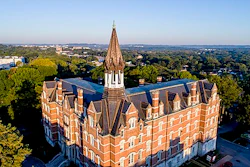
JACKSONVILLE, Fla. — Black students at the University of North Florida rallied for the preservation of the African American Student Union after a student government agency decided the organization was unconstitutional.
The decision last month to dissolve the African American Student Union was made by a 2-to-1 vote of the four-student judiciary court. The student body president then froze the union’s budget and ordered it to leave its campus headquarters.
But about an hour after the beginning of a student protest, student government leaders agreed to stay the course until the matter can be resolved.
The African American Student Union receives about $47,000 a year for programs aimed at 1,200 African American students who comprise about 10 percent of the university’s population and are the largest minority group on campus.
By comparison, groups that focus on other minority cultures, such as the Vietnamese and Hispanic students, will receive about $400 this year.
North Florida’s president, Dr. Anne Hopkins, met with student leaders and asked them to try and resolve the conflict themselves. The administration, she said, would help if requested.
“The whole idea behind student government is letting them learn,” she says. Student Senator Michael Wright contends the existence of the African American student union violates the 14th Amendment of the U.S. Constitution, which requires racial classifications must serve a compelling government interest.
A formal appeal of the student judiciary opinion willl give the union about a month to make its case. LaShawn Woodburn, the director of the union, says the challenge will succeed because union events are open to all students.
UCLA Law Students Protest Against Admission Policies
LOS ANGELES — About 200 students and professors staged a walkout here late last month to protest admissions policies at the University of California-Los Angeles where only two Black students are among the law school’s freshman class.
Protesters at the two-hour teach-in urged law school admissions officials to do more to recruit ethnic minorities, especially in the wake of Proposition 209, the statewide ballot measure that bars ethnic and gender considerations in state hiring, contracting and public university admissions.
“It’s very difficult — there are times I feel isolated and excluded, an outcast from my classmates,” says Crystal James, one of the two African American students admitted among all the 286 new students this fall.
The university’s incoming law school class has 126 Whites, 66 Asian Americans, 17 Hispanics students and one American Indian. The ethnic background of the remaining 74 students was not known.
In 1996, the class that enrolled before Proposition 209, there were 19 Black students, 45 Hispanics, 48 Asian Americans, five American Indians and 188 Whites or those whose ethnicity was unknown.
Fewer ethnic minorities are being accepted but many of those who are eligible choose to attend a different college, law school officials say. Of the 233 Black students who applied this year, 18 were admitted but just two enrolled. In 1996, 399 Black students applied, 104 were admitted and 19 enrolled.
“The real world has people of color in it. You can’t teach in a segregated atmosphere — it just can’t be done,” says professor Gary Blasi.
Protesters urged the university to subsidize law school admissions test preparations for disadvantaged students and recommended minority students be given “significant decision-making power” in evaluating law school applications.
University of California system rules prohibit students from voting on the admission of other students, says law school dean Jon Varat, adding that he, too, is unhappy with the lack of diversity.
Former Central State President Challenges Arbitration Decision
WILBERFORCE, Ohio — The former president of Central State University last month challenged an arbitration panel’s ruling that would have forced him to repay about one-third of the severance pact he reached with university officials in 1995.
Dr. Arthur E. Thomas filed an appeal in Greene County Common Pleas Court contending he should not have to give back $102,286 of the $325,000 settlement. The action means the case likely will go before a jury, possibly in February.
In his appeal, attorney Larry James argued that the arbitration panel’s award “is against the manifest weight of the evidence and is contrary to law.”
But attorneys for the state want Thomas to repay the money, saying the settlement was excessive. The disputed payment is mostly for accrued vacation time and sick leave. State auditors say such payments are illegal.
Thomas has testified the time was well earned because he virtually never took sick or vacation leave and worked “from dawn to dusk” on behalf of Ohio’s lone historically Black public university.
He served as a top administrator there for 18 years, 10 as president. Thomas resigned as the university came under increasing pressure from legislators, higher education officials and then-Gov. George Voinovich.
They blamed the university’s much-publicized financial problems on Thomas. But a lengthy criminal investigation yielded no indictments and officials acknowledge there is no evidence Thomas or others lined their own pockets with university funds.
Racially Tinged Display Removed
TEMPE, Ariz. — Arizona State University officials late last month forced an African American student to take down a display that included a racial epithet referring to Blacks less than 24 hours after it went up.
The display, said to have been erected by the student as an expression of his attitude toward his roots, was built from white plastic pipe covered with cheesecloth and had photocopied pictures of African Americans on it, university officials say.
Scattered on the ground was literature relating to the Rev. Martin Luther King Jr. and Malcolm X. “First, you have to have permission to erect a structure on campus. Second, we don’t condone hate messages like this,” says university spokeswoman Nancy Neff.
State Senator Says Not Enough Blacks in Nevada Medical School
CARSON CITY, Nev. — State Sen. Joe Neal has renewed his criticism of the University of Nevada School of Medicine, noting there are only 11 Blacks among nearly 1,000 students who graduated from the school since 1980.
Neal, a North Las Vegas Democrat who is Black, blames “cultural bias” for the low number of minority medical students and alleges that 90 percent of U.S. medical schools have more Blacks in their first-year class than Nevada has had in 15 years.
“The school can find very good excuses why they can’t find minority applicants,” Neal recently told members of the Regents’ Academic, Research and Student Affairs Committee. “But mostly, once you adopt a culture where you don’t think minority students qualify, you discard them.”
Dr. Joe Crowley, president of the University of Nevada, Reno, agrees that the medical school’s biggest problem is “underrepresentation of certain minorities — African Americans, Native Americans and to a lesser extent, Hispanics.”
But Dr. Steven Montoya, a member of the medical school admissions selection committee, defends the university’s numbers, saying, “We’re not admitting numbers, we’re admitting future doctors.”
Women Basketball Players Sue Over Treatment by Coach
BOSTON — Three former players on the University of Massachusetts women’s basketball team have filed a lawsuit against the school because they say their coach’s yelling, insults and obscenities made their personal lives unbearable.
Kara Trent, Nicole Vallieres and Tory Grant filed the suit late last month in U.S. District Court here in Boston, claiming that coach Joanie O’Brien’s coaching style left them humiliated and anguished.
They also contend the behavior defies the principles of the National Collegiate Athletic Association.
“Kara Trent came to the point where she dreaded and became fearful of playing and came to hate the game of basketball, which she had loved and played since her third grade of elementary school,” attorney Brian Woolf, who represents the three, wrote in the complaint.
“This was a hostile environment and the university didn’t do a thing about it,” Woolf says. Trent, 20, a junior studying sports management, is the only plaintiff still attending the university.
The women, teammates during the 1997-98 season, are seeking a total of $45 million in damages. University spokeswoman Kay Scanlan declined comment. O’Brien did not immediately return telephone calls seeking comment.
Trent told her lawyer that O’Brien, 35, who is entering her ninth season with the university, would violently grab her by the jersey neck and pull her onto place on the court, and shout in her face.
Grant also complains she was the victim of sexual discrimination because the coach thought she was gay, and says she was unfairly thrown off the team in October 1998 after she was caught smoking marijuana. n