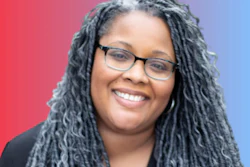
Dr. Jennifer Jolley describes herself as a composer, conductor and professor. An associate professor and department chair in the School of the Arts and Humanities in the Department of Music, Multimedia, Theatre & Dance at Lehman College in New York, she believes that music enhances the higher education experience regardless of a student’s major or field of study.
Log in to view the full article
Dr. Jennifer Jolley describes herself as a composer, conductor and professor. An associate professor and department chair in the School of the Arts and Humanities in the Department of Music, Multimedia, Theatre & Dance at Lehman College in New York, she believes that music enhances the higher education experience regardless of a student’s major or field of study.
Her Korean immigrant mother had influence on her development as an artist, insisting she study piano, which Jolley dutifully did. Growing up Korean American, she felt she was not Asian enough. “It wasn’t until around the pandemic where I started becoming more confident in who I was and what my heritage was,” she says. “It is OK to have references to Korean culture and Koreanness. I’ve written a few pieces that kind of conjure Korean influenced music. I wrote a piece for solo percussion that’s based on a Korean dance drumming genre.”

Jolley’s work has been performed by ensembles worldwide. She has received commissions from the National Endowment for the Arts, the MidAmerican Center for Contemporary Music, the Left Coast Chamber Ensemble, Quince Ensemble, Vermont Symphony Orchestra and many others. Her compositions often reflect political and provocative subjects, including climate change and feminist history.
“The way that I have discourse with the world is writing about subjects that I care deeply about,” Jolley explains. “I am not an essayist; I express myself through my music. I have written pieces about things that I’m curious about or experiencing. I have a piece called ‘Ash’ (for a wind ensemble, adaptable ensemble or chamber), where I conjure images of when I was in kindergarten (in Southern California) seeing ash fall from the sky due to California wildfires.”
As young as 12, she knew she had a knack for teaching, and being in academia gives her the opportunity to live that dream. Prior to coming to Lehman College (part of the City University of New York), Jolley held positions at Texas Tech and Ohio Wesleyan, and has been a composition faculty member at Interlochen Arts Camp. Now a tenured professor at an urban institution, she gets to introduce ideas and concepts to students in courses such as music theory, which analyzes music and explains the musical patterns that composers tend to use, and orchestration. A dynamic course she taught is opera and social justice, an honors class, for which she was able to get dress rehearsal tickets to the Metropolitan Opera.
“A lot of operas that we covered, we talked about social themes,” Jolley notes. “The Met was premiering the opera ‘Grounded,’ which talked about drone warfare. … All the students were not music majors and a lot of them had never seen an opera before. I had them watch Anthony Davis’ Malcolm X opera, ‘X: The Life and Times of Malcolm X,’ and a few of my students said, ‘We never saw ourselves on stage before.’ … Composers have something to say about historical events.”
They spoke about class structure issues in “The Marriage of Figaro” and immigration issues presented in Julia Wolfe’s 2019 piece “Fire in My Mouth,” about the Triangle Shirtwaist Factory fire of 1911, which happened in New York City. The students responded enthusiastically to exploring social justice themes through opera.
In terms of composition, Jolley is working on an opera about the first all-women spacewalk. This work is funded in part by a grant from OPERA America. She has utilized things the astronauts (in 2019) actually said in space.
Another project has considerable academic possibilities, the Music Encoding Initiative (MEI). “As a composer, I am now thinking how do I preserve my music,” Jolley says. “I’m now in the music encoding pedagogy group where I’m learning how to not only digitally encode different types of music with a certain programming jargon that will include metadata that will help other researchers figure out facts about this music, but I’m also learning how to teach it to my students. I’m hoping that at Lehman College I’m able to create a class where I teach them how to digitally encode using MEI to preserve different types of music throughout the centuries and different cultures.”
This article originally appeared in the May 7, 2026 print edition of The EDU Ledger.