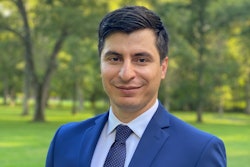
Title: Assistant Professor, College of Arts & Sciences-Social Work Department, Rutgers University-Newark
Log in to view the full article
Title: Assistant Professor, College of Arts & Sciences-Social Work Department, Rutgers University-Newark
Education: Ph.D., Social Work, Howard University; MSW and B.A., Stony Brook University
Age: 41
Career mentors: Dr. Sandra E. Crewe, Howard University; Dr. Jorge Burmicky, Howard University; Dr. Timothy Eatman, Rutgers University; Dr. Tamarah Moss, Bryn Mawr College; Dr. Juan Antonio Rios Jr., Seton Hall University
Words of wisdom/advice for new faculty members: “Audre Lorde reminds us that if we don’t define our own purpose and identity, others will do it for us. As new faculty, it is essential to be intentional about who you are as a scholar, educator, and community member. Establish your values early, communicate them clearly, and protect the boundaries that allow you to thrive. Otherwise, the institution — its expectations, its culture, its pressures — will define you in ways that may not serve your wellbeing or your purpose.”
 Dr. Natalie Muñoz
Specifically, she invites students to design their own paths of study based on their individual identities. They seek to build a better understanding of themselves. They do this by studying their heritage within what Muñoz refers to as a “diasporic context.”
They pore through archives and genealogical records of their ancestors. They take genetic tests to discover more about their origins. They discuss what it means to deconstruct and “decolonize” internalized narratives that arise from a history of oppression.
Muñoz — a professor of social work at Rutgers-Newark – has an answer for anyone who questions what anyone’s past has to do with being an effective social worker today.
“You need to — I feel — be centered and grounded in who you are before you can help other people,” Muñoz – who specializes in AfroLatine identity development and mental health equity — told The EDU Ledger in a recent interview. “Because how can you heal other people if you’re not thinking about your own healing?”
The matter is particularly important for future social workers of color, Muñoz says.
“I think it’s a little narcissistic to think, ‘Oh, I’m perfect, and I’m just gonna go heal other people,’ when the reality is, especially for Black and Brown therapists and social workers, a lot of the work that we’re doing can be triggering,” Muñoz says.
“And I think it’s important to heal first before we go into this work,” she says. “Otherwise, we’re just transferring some of that anger to our clients and maybe not even conscious of it.”
Even though Muñoz speaks of having hit the “glass ceiling” that she and others say exists for women of color in higher ed, she doesn’t let it dissuade her. She expends her time and energy on reaching a broader audience through her scholarship. For instance, she posts videos on a new YouTube channel she established in 2024 called “Azúcar TV.” The channel “highlights the beauty and richness of AfroLatine culture, history, and healing traditions,” according to a description on the site.
A recent episode explored an HBCU student’s journey toward embracing the Black part of his identity as a child of parents from the Dominican Republic.
Ángel de Jesus González, an assistant professor of higher education administration at Cal State University, Fresno, knows Muñoz through their mutual climb in higher education. He got to know her better during a fellowship they both had in the 2024-25 academic year through the American Association of Hispanics in Higher Education.
González lauds Muñoz for her “socially transformative” scholarship and developing courses in which AfroLatine students are represented.
“So when students go into her classroom, not only do they see they’re represented because of her, but in the work that they’re engaging with,” González says.
It’s not hard to find evidence of Muñoz’s impact on upcoming scholars.
In November, for instance, Muñoz shared news about a full-circle moment that occurred when she got to serve on the dissertation committee for one of her former Latina mentees. The student successfully defended her dissertation proposal.
She first met the student over a decade ago at St. John’s University, when Muñoz led the RISE Network, a peer mentoring program for Black and Latinx students.
“Her proposal wasn’t just powerful; it reminded me of a younger version of myself, frustrated with inequities yet determined to be part of the change,” Muñoz shared. “Watching her step into her own scholarly power felt like witnessing the next chapter of a story we’re all writing together.”